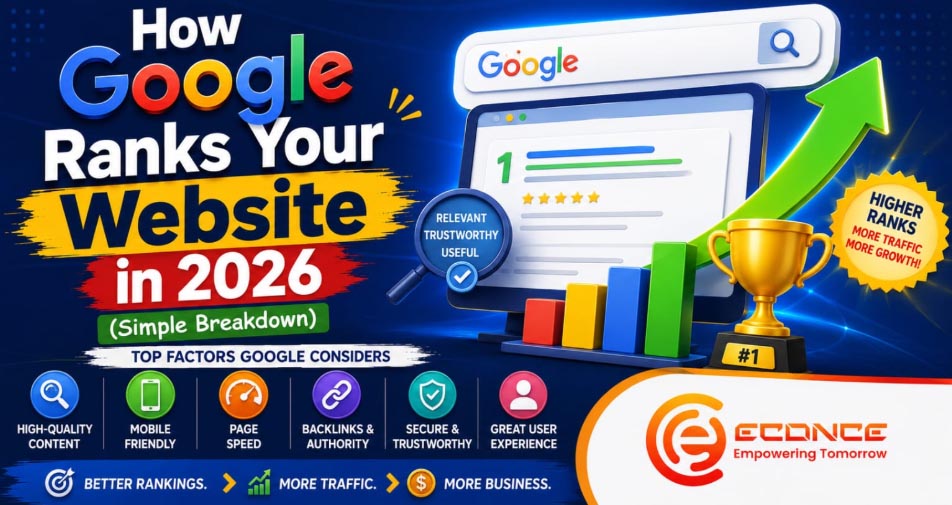
How Google Ranks Your Website in 2026 (Simple Breakdown)
Understanding Google’s Ranking System in the Age of AI Search
Every business owner wants the same thing:
“How do I get my website to rank on the first page of Google?”
Whether you’re a doctor, real estate consultant, law firm, educational institute, manufacturer, startup, or local service provider, appearing prominently on Google can significantly impact your business growth.
The challenge is that many business owners still believe Google rankings are based solely on keywords or backlinks. While those factors remain important, Google’s ranking system in 2026 has evolved dramatically.
Today, Google uses advanced Artificial Intelligence, machine learning, user behavior analysis, content quality signals, website performance metrics, local relevance indicators, and hundreds of other ranking factors to determine which websites deserve top positions.
The good news?
You don’t need to understand every algorithm update to improve your rankings.
At Econce Technology Management Services LLP, we help businesses improve their Google visibility through SEO, website optimization, local search marketing, content strategy, technical SEO, and digital growth consulting. This guide provides a simple breakdown of how Google ranks websites in 2026 and what your business can do to improve search engine rankings.
Why Google Rankings Matter More Than Ever
Before understanding rankings, it’s important to understand why visibility matters.
When people need a service today, they search online.
Examples include:
- Best pediatrician near me
- Real estate consultant in Ahmedabad
- Digital marketing company in Kolkata
- Website development company
- Orthopedic doctor in Indore
- Interior designer near me
- SEO agency for small business
Research consistently shows that most users never move beyond the first page of search results.
If your website is not visible, potential customers often choose competitors before ever discovering your business.
That’s why Search Engine Optimization (SEO) remains one of the highest ROI digital marketing investments available.
Step 1: Google Must Find Your Website
Before Google can rank your website, it must first discover it.
This process is called crawling.
Google uses automated systems called crawlers or spiders that visit websites and collect information about pages.
The crawler examines:
- Website content
- Images
- Links
- Page structure
- Technical information
- User experience elements
If your website is poorly structured or difficult to access, Google may struggle to understand it.
Common Problems
- Missing sitemap
- Broken pages
- Slow loading speeds
- Poor navigation
- Technical errors
- Duplicate content
How to Improve
Businesses should ensure:
- XML sitemap submission
- Clean website structure
- Internal linking
- Fast loading pages
- Mobile responsiveness
At Econce Technology Management Services LLP, technical SEO audits help identify and resolve crawling issues that prevent websites from achieving strong search visibility.
Step 2: Google Tries to Understand Your Content
Once Google discovers your website, it attempts to understand what each page is about.
This process is called indexing.
Google analyzes:
- Headlines
- Page titles
- Meta descriptions
- Website content
- Images
- Keywords
- Context
- User intent
Modern Google algorithms no longer focus only on exact keywords.
Instead, they evaluate topic relevance and overall content quality.
For example:
A page optimized for:
“Pediatrician in Ahmedabad”
may also rank for:
- Child specialist Ahmedabad
- Children’s doctor near me
- Pediatric clinic Ahmedabad
- Child healthcare specialist
because Google understands semantic relationships between terms.
Step 3: Content Quality Plays a Major Role
In 2026, content quality remains one of Google’s strongest ranking factors.
Google wants to deliver the most helpful answers to users.
When evaluating content, Google asks:
- Is the information useful?
- Does it answer the user’s question?
- Is the content original?
- Is it trustworthy?
- Is it comprehensive?
- Is it up-to-date?
Thin or low-quality pages struggle to rank.
Examples of High-Quality Content
- Educational blogs
- Service pages
- Case studies
- Industry guides
- FAQs
- Resource articles
- Expert insights
Businesses that consistently publish valuable content generally experience stronger search visibility over time.
This is why content marketing remains a core component of SEO services provided by Econce Technology Management Services LLP.
Step 4: Search Intent Is More Important Than Keywords
One of the biggest SEO changes in recent years is Google’s emphasis on search intent.
Google tries to understand why someone is searching.
For example:
When a user searches:
“Best CRM software”
they may want:
- Product comparisons
- Reviews
- Recommendations
When someone searches:
“CRM software pricing”
they may be closer to making a purchase decision.
Google ranks pages that best satisfy the searcher’s intent.
This means businesses must create content designed for different stages of the customer journey.
Step 5: Website Speed Influences Rankings
Nobody likes slow websites.
Neither do search engines.
Google evaluates how quickly pages load across desktop and mobile devices.
Slow websites often experience:
- Higher bounce rates
- Lower engagement
- Poor user experience
- Reduced rankings
Important Performance Factors
- Page load speed
- Image optimization
- Server performance
- Mobile responsiveness
- Core Web Vitals
Businesses investing in website optimization often see improvements in both rankings and conversions.
At Econce Technology Management Services LLP, website performance optimization forms an essential part of modern SEO strategies.
Step 6: Mobile Friendliness Is Mandatory
More than half of online searches now occur on mobile devices.
Google uses mobile-first indexing, meaning it primarily evaluates the mobile version of a website.
If your website:
- Doesn’t fit mobile screens
- Loads slowly on smartphones
- Has difficult navigation
- Contains unreadable text
rankings may suffer significantly.
Mobile SEO Best Practices
- Responsive design
- Fast mobile loading
- Simple navigation
- Clickable buttons
- Optimized images
A mobile-friendly website is no longer optional—it’s a requirement.
Step 7: User Experience Affects Rankings
Google wants users to have positive experiences.
When visitors arrive on your website, Google evaluates behavioral signals such as:
- Time spent on site
- Pages viewed
- Bounce rates
- Engagement levels
- Navigation patterns
Although Google does not reveal every ranking signal, websites providing excellent user experiences generally perform better.
Improve User Experience By:
- Clear navigation
- Fast loading pages
- Easy-to-read content
- Strong visual design
- Helpful information
- Simple contact options
Step 8: Backlinks Still Matter
Backlinks remain one of Google’s strongest authority signals.
A backlink occurs when another website links to yours.
Google views quality backlinks as endorsements.
The more trustworthy websites that link to your content, the more authority your website gains.
Valuable Backlink Sources
- Industry websites
- Business directories
- Professional organizations
- Local publications
- News websites
- Industry blogs
However, quality matters far more than quantity.
A few authoritative backlinks can outperform hundreds of low-quality links.
Step 9: Local SEO Is Critical for Local Businesses
If your business serves a specific geographic area, local SEO is extremely important.
When users search:
- Dentist near me
- Doctor in Kolkata
- Property consultant in Ahmedabad
- SEO company near me
Google prioritizes locally relevant businesses.
Local Ranking Factors
- Google Business Profile optimization
- Business citations
- Customer reviews
- Local keywords
- Location relevance
- Website authority
Many businesses overlook local SEO opportunities and lose valuable leads as a result.
Econce Technology Management Services LLP helps local businesses strengthen Google Maps visibility and local search rankings through comprehensive local SEO strategies.
Step 10: Reviews Build Trust and Visibility
Online reviews influence both customers and search engines.
Businesses with strong review profiles often experience:
- Better visibility
- Increased trust
- Higher click-through rates
- Improved conversions
Google views reviews as signals of credibility and customer satisfaction.
Encourage Reviews Through:
- Follow-up emails
- WhatsApp requests
- Customer satisfaction programs
- Automated review campaigns
Consistent review generation can significantly improve local search performance.
Step 11: AI Search Is Changing SEO
Google’s AI-powered search experiences are transforming how information is presented.
Instead of simply displaying links, Google increasingly provides AI-generated summaries and recommendations.
To remain visible in AI-enhanced search results, businesses need:
- Expert content
- Clear answers
- Topic authority
- Structured information
- Trustworthy sources
Businesses that create valuable educational content are better positioned for visibility in AI-driven search environments.
This trend makes content quality more important than ever before.
The Most Important Ranking Factors in 2026
If you simplify Google’s ranking system, the most influential factors include:
Content Quality
Helpful, relevant, authoritative content.
Search Intent Match
Pages that answer user questions effectively.
Website Performance
Fast, secure, mobile-friendly websites.
Technical SEO
Proper website structure and optimization.
Backlinks
Authority and trust signals from other websites.
User Experience
Positive visitor engagement and satisfaction.
Local SEO
Location relevance and Google Business Profile optimization.
Reviews and Reputation
Customer trust indicators.
Content Freshness
Updated and current information.
AI Readiness
Well-structured content suitable for modern search experiences.
Common SEO Mistakes That Hurt Rankings
Many businesses unknowingly damage their rankings by:
- Stuffing keywords unnaturally
- Publishing thin content
- Ignoring technical SEO
- Using duplicate content
- Neglecting mobile optimization
- Failing to update websites
- Ignoring local SEO
- Building low-quality backlinks
- Having slow-loading pages
- Not tracking performance
Avoiding these mistakes alone can create substantial ranking improvements.
How Econce Technology Management Services LLP Helps Businesses Rank Higher
Achieving strong Google rankings requires more than simply adding keywords to a website.
At Econce Technology Management Services LLP, our SEO and digital growth strategies focus on creating complete search visibility ecosystems.
Our services include:
Search Engine Optimization (SEO)
- Keyword research
- On-page SEO
- Technical SEO
- Content optimization
- Link-building strategies
Website Development
- Mobile-responsive design
- Speed optimization
- Conversion-focused layouts
- SEO-friendly architecture
Local SEO
- Google Business Profile optimization
- Maps ranking improvement
- Citation management
- Review strategies
Content Marketing
- Blog writing
- SEO content creation
- Authority-building content
- Educational resources
Analytics & Reporting
- Ranking monitoring
- Traffic analysis
- Conversion tracking
- Performance reporting
This integrated approach helps businesses improve search visibility, generate qualified leads, and strengthen their online presence.
Final Thoughts
Google’s ranking system in 2026 is smarter, faster, and more user-focused than ever before.
The days of manipulating rankings through shortcuts are largely over.
Today’s search success comes from providing genuine value through:
- High-quality content
- Excellent user experience
- Strong technical foundations
- Local relevance
- Website performance
- Authority and trust
Businesses that consistently focus on helping users solve problems are the businesses most likely to rank well.
If your website is not generating enough traffic, inquiries, or customers, the issue is often not visibility alone—it is the combination of SEO, content, technical optimization, user experience, and digital strategy.
Econce Technology Management Services LLP helps businesses build these foundations, improve Google rankings, attract high-intent visitors, and convert online searches into real business opportunities.
Because in 2026, ranking higher on Google is no longer just about being found—it is about becoming the most trusted answer when customers are searching for solutions.